


On November 15th, the SCO Young Scientists Conference, hosted by Qilu University of Technology (Shandong Academy of Sciences), opened in Jinan. Li Hong, Deputy Director of the Office of the Foreign Affairs Commission of the Shandong Provincial Committee of the Communist Party of China; Zhu Enyuan, Member of the Party Group and Deputy Director of the Shandong Provincial Department of Science and Technology; Li Tianchuan, Director of the China-Shanghai Cooperation Organization Science and Technology Innovation Cooperation Center and Secretary of the Party Group and Director of the Qingdao Municipal Science and Technology Bureau; Zhukov Alexei, Corresponding Member of the Russian Academy of Sciences and Professor at the Russian State University of Higher Economic Research Wu Yantao, the Party Secretary of the university , Shu Minglei, the Vice Presidentof the university and other domestic and foreign guests attended the opening ceremony.

Wu Yantao stated that Qilu University of Technology (Shandong Academy of Sciences) has always adhered to the concept of “rooted in Shandong, serving the whole country, and facing the SCO”, and has established friendly cooperative relations with many universities and research institutions in SCO countries. Young scientists are the vital force of scientific and technological innovation and also the vanguard force promoting international academic exchanges. The university will strengthen collaborative innovation and strive to build a “demonstration platform” for international scientific and technological cooperation. Accelerate the transformation of achievements and strive to build a “power engine” that empowers industrial development. Stimulate vitality and momentum, and strive to build a first-class “aggregation highland” for innovative talents. Build the SCO Science and Technology Innovation Center of high quality and support young scientists from SCO countries to start businesses and innovate at the university.

The meeting was presided over by Shu Minglei.

Zhu Enyuan proposed that Shandong Province is a major province in scientific and technological innovation. It has established scientific and technological cooperation relations with over 90 countries and regions around the world. Currently, it is working with all parties to promote the construction of the SCO Science and Technology Innovation Center, and the provincial scientific and technological cooperation plan projects will also be open to young scientists from SCO countries.

Zhukov and other foreign expert representatives said in their speeches that modern science knows no borders and they look forward to deepening cooperation among young scientists in fields such as quantum technology, new materials, artificial intelligence, and biophotonics.

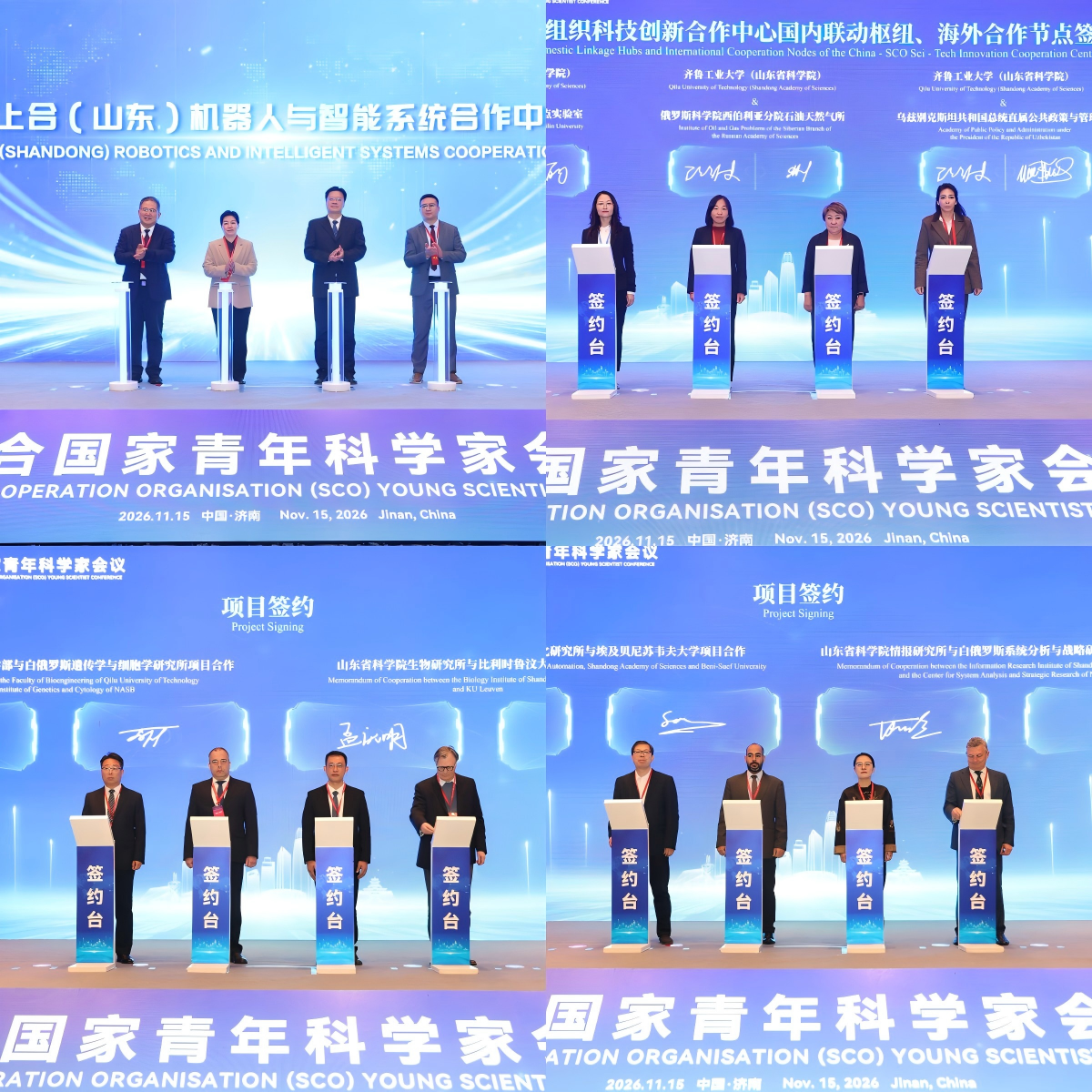
At the opening ceremony, a number of international cooperation projects were signed, involving cooperation by the Institute of Automation, the Institute of Scientific and Technical Information, and the Institute of Biology of the Shandong Academy of Sciences, as well as Qilu University of Technology (Shandong Academy of Sciences), with universities and research institutions in Egypt, Belarus, Belgium, and other countries. Relevant parties, together with several key laboratories in China and universities and research institutions in SCO member states, have jointly established domestic linkage hubs and international cooperation nodes for the China-SCO Sci-Tech Innovation Cooperation Center. The opening ceremony also featured the unveiling of the China-SCO Sci-Tech Innovation Cooperation Center at Qilu University of Technology (Shandong Academy of Sciences) and the launch of the construction of the China-SCO (Shandong) Center for Cooperation on Robotics and Intelligent Systems, showcasing Shandong’s sci-tech cooperation achievements and platform layout with SCO member states and countries participating in the Belt and Road Initiative.
Several Chinese and foreign academicians and experts delivered keynote speeches sharing the latest research progress and industrial transformation trends in the fields of laser physics and photonics, quantum technology, and biophotonics. The conference also set up two sub-forums: intelligent perception and advanced manufacturing, and synthetic biology and nucleic acid chemistry. Young scientists conducted in-depth discussions on themes such as new-generation information technology, new energy, biomedicine, technology transfer and international joint training, and carried out project matching and negotiation with representatives from universities, research institutes and enterprises in the province.
The relevant responsible comrades from the International Cooperation Office, the Department of Optoelectronics, the Department of Biology, the Institute of Intelligence and other departments attended the meeting. More than 80 domestic and foreign guests attended the meeting, including academicians and experts from Russia, Belarus, Uzbekistan, Belgium, the United Kingdom and other countries, responsible officials from relevant provincial departments, and representatives from universities, research institutes and enterprises within the province.
